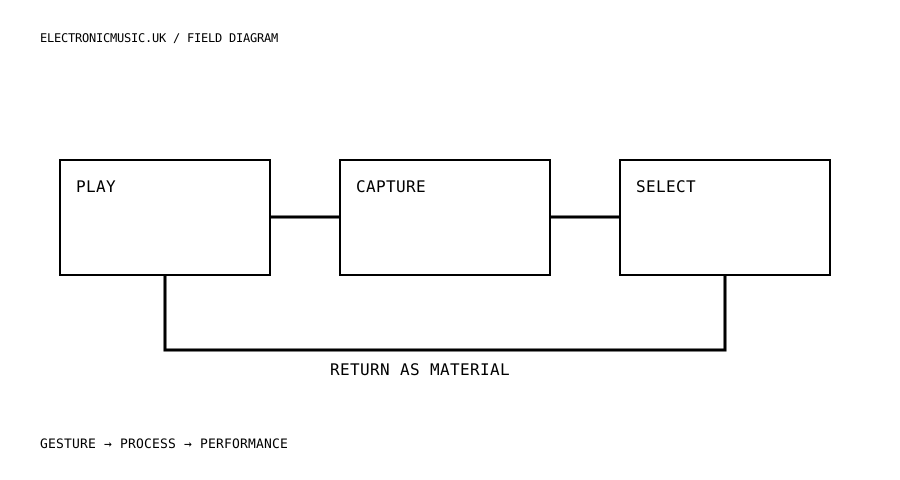
Give the next recording a job
Resampling is an arrangement tool when you know why you are printing the sound. You might want to preserve an unstable phrase, free the controls for another gesture, or turn a complicated interaction into something you can trigger in time. Name that purpose before adding another effect. A recording called opening-friction is more useful during rehearsal than a folder of nearly identical experiments.
Build one source and one transformation first. The source might be a short percussive pattern; the transformation could turn its tail into a continuous texture. Play a full minute before recording. Find three moments worth keeping: a sparse opening, a dense middle and a release. You are looking for material with different functions, not three increasingly impressive versions of the same climax.
Follow the actual signal path
Schwung is an unofficial layer for Move, with its own modules and routing. Its current manual distinguishes native sampling, mixed resampling and a bar-quantised recorder. For native sampling of Schwung output it specifies Resample set to Mix, the Move sampler source set to Line In, and monitoring Off. Follow the current manual for your installed version; monitoring the return can create a feedback path.
The optional Move-to-Schwung Link Audio route has additional requirements and changes the mix path. The manual requires Move 2.0.0 or later and explains that native Move Master FX are bypassed in that route. Do not compare two routings while assuming their processing is identical. Make a simple dry reference first, then add the desired processing and check the result again.
Draw the route with five boxes: source, slot processing, send, master processing and recorder. Mark where the signal is tapped. This small drawing prevents a common mistake: hearing an effect in the headphones and assuming it has been printed into every file. It also helps explain why a stem and a finished stereo mix may sound different when brought into a DAW.
Print a phrase with an entrance and an exit
Start recording before the first intended sound and leave time after the last gesture. For a strict rhythmic loop, choose a length that includes a coherent transition back to its beginning. For a texture, preserve a clean entrance and a useful decay instead of forcing everything into a seamless loop. These are different kinds of material and deserve different names.
Play the transformation once with a clear trajectory. Open the filter over a phrase, bring the repeat into focus, then remove the source so the tail can speak. Avoid continually adjusting every available control. A good sample often contains one audible argument. If the effect has swallowed the original rhythm, print a second, simpler version so the set retains somewhere to return.
Listen to each capture without the live source. A doubled source can make a thin recording seem convincing during capture, then disappear when you try to use the file alone. Conversely, a strong printed transient may become too loud when layered with its original. Decide whether the new recording replaces the source, supports it or interrupts it. Establish that role before collecting more material.
Keep the performance and the repair options
Schwung’s current recording options include master and stem outputs. Its documentation states that stems are taken before Master FX and the volume control. Consequently, processed master audio is not necessarily reconstructed by simply summing those stems. Save the stereo take when the master processing is part of the performance, and keep stems when you want later balance changes.
Build a small rehearsal set from the three recordings. Allow yourself only their levels, one send and a mute. If the arrangement still has direction, the captures contain useful decisions. If it falls flat, return to the source and make a more distinct entrance or release. Buying another effect is unlikely to solve a lack of contrast between the recordings.
Finally, rehearse a failed capture. Continue playing when a loop is too short, a tail is truncated or a file is not where you expected. Have a familiar dry phrase available while you recover. This is the practical payoff of resampling: you can spend attention on the next musical move because some earlier decisions have become stable, reusable material.
Try this.
Capture an opening, a dense passage and a release from one source. Arrange two minutes using only these files, levels and a single send. Keep both the performed master and any useful stems, with routing notes.
Listen back
- Does this capture replace, support or interrupt its source?
- Where is the recorder relative to the master effects?
- Can the set continue while a capture is rejected?