An instrument you can read
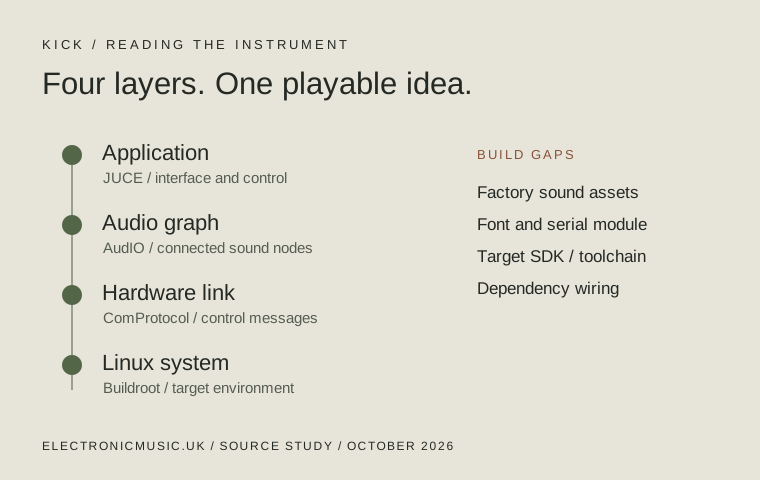
Music Tribe has published the source repository for Behringer KICK, describing a touchscreen sampler, sequencer and looper with sixteen RGB pads across eight banks. The interesting part for instrument builders is the division of labour: a JUCE application handles the interface, AudIO supplies the sound graph, ComProtocol carries control messages, and a Buildroot tree assembles the Linux system beneath them.
That gives us something more useful than a feature list: places to look when asking how a gesture becomes a sound. This is a source-code first look, not a hands-on hardware review. The repository does not establish a retail price or release date, and we have not built or flashed its firmware.
Start with the sound graph
AudIO is documented as a graph of connected processing nodes: oscillators, envelopes, mixers, sample playback and recording. Its guide describes more than 300 effects drawn from Airwindows, alongside SoundFont support. It can be integrated as a JUCE module or built with CMake. Those boundaries are useful even if you never intend to reproduce KICK itself.
A graph makes the path from input to output explicit. The musical question is which connections should stay fixed and which deserve a performer’s hand. A small change to an envelope or routing choice may be more revealing than adding another page of effects. Read one node and its connections before attempting to understand the whole instrument.
Public source is not a complete build kit
The application’s own guide says it will not build out of the box. It lists removed factory sounds, metronome and percussion assets, a proprietary font, a prebuilt target SDK and a serial-port module that could not be redistributed. The SDK must be obtained through the documented Buildroot toolchain route. AudIO also identifies a removed E-mu SoundFont and demo drum content; replacements need to be supplied by the builder.
There is a documentation mismatch worth resolving before spending time on a build. The application guide still refers to private AudIO and ComProtocol dependencies, although directories for both are present in the public repository. Their presence does not prove the application’s dependency paths are already wired correctly.
The application, AudIO and ComProtocol are published under AGPL version 3 or later; the Linux build tree uses GPL version 2, with individual packages retaining their own licences. Bundled components have additional notices, and the software licences do not grant rights to Behringer or Music Tribe branding. Check the component you intend to reuse, not just the repository’s headline licence.
A useful place to begin
For now, treat the repository as a study in instrument architecture. Follow a control from the interface towards an audio parameter, then write down the smallest change you would want to hear. Keep asset replacement, target toolchain and dependency wiring as separate questions rather than treating the first compiler error as the whole problem.
One concrete build detail matters: the Linux guide describes a development image with passwordless root access and Dropbear SSH enabled. That configuration needs securing before a resulting device is exposed to a network. Publishing source makes this visible; it does not make the development image a finished consumer setup.
Try this.
Sketch a four-part instrument: a playable surface, an audio graph, a hardware-message link and the operating system. Choose one gesture, such as pad pressure opening a filter, and trace which parts need to carry it. Use the KICK guides to mark what is documented, what depends on missing assets and what still needs a build test. No hardware or firmware installation is needed for this exercise.
Listen back
- Which single control would make this instrument feel personal to you?
- Can that change stay inside the audio graph, or does it need a new interface or hardware message?