Give the moving note something to lean against
A long bend is more legible when something beside it refuses to move. That fixed point might be a quiet fifth, a noisy recording or a held note under another finger. Without it, a slide can become a gesture with no consequence. Against it, the same movement changes the interval, the beating and the apparent weight of the phrase.
This session uses Noise/Signal’s Drone and Attractor. The aim is a small performance with three distinct behaviours: a recorded bed that repeats its breathing, a live reference note, and a second live note that approaches and leaves the first. It is a proposed exercise for the browser studio, not a report of a tested hardware performance. You can also use the arrangement with another MPE synth and a recorder.
Make the gesture arrive in the right place
MPE gives notes separate MIDI channels so pitch bend, pressure and timbre messages can reach individual voices. The usual expression signals are pitch bend, channel pressure and CC74; the controller and receiving instrument still need compatible settings. Selecting a controller’s name alone does not establish the zone or pitch range.
In Noise/Signal, choose the controller at the top and set MIDI / MPE to the Attractor track explicitly. That keeps the performance routed there while you inspect the drone or mixer. Open Audio & MIDI to check the zone and member bend range. The studio defaults to lower-zone MPE with a ±48-semitone member range. Match the controller rather than assuming that every preset sends the same thing.
On LinnStrument, Roger Linn’s sound-design guide describes a Channel Per Note shortcut that sets MPE, ±48 bend, CC74 and channel pressure. Its panel manual distinguishes initial pitch quantisation from pitch correction during a held note. For an unbroken slow glide, try initial quantisation with Hold correction off; compare the slow Hold option if settling onto a pitch is more important. Slide to a known neighbouring pad and check the destination pitch before judging the patch. Other controllers have different controls for this behaviour.
Print a bed with room inside it
Set the studio to D Dorian at 72 BPM and keep Master low. On a Drone track, begin with the Breath preset. Reduce Growl, bring Noise mix down to about 0.1 and use a slow breathing cycle. Hold the drone and listen through several cycles. If the noise obscures the pitch, reduce it before adding anything else. These are starting values, not a target sound you must reproduce.
Arm only that track, use Record armed and make a short bed of roughly a minute. Release the drone towards the end and leave a little decay before stopping. Switch the channel to Tape and disarm it. Rewind and listen: the bed should now exist as recorded audio, freeing you to concentrate on a live voice. If it feels crowded already, make another simpler take. A richly modulated background can spend all the space the lead will need.
Leave tape speed at 1× for the first experiment. Speed changes pitch as well as duration, so changing it later changes the reference you are playing against. That can be the composition’s turning point; it is less useful as an unexplained tuning problem at the start.
Two notes need two voices
Select Attractor and open Sound. Choose the Reed generator and Polyphonic MPE. Start with Bite around 0.2, Fold around 0.15, Instability low, Cutoff near 2,500 Hz, modest Resonance and a short release around half a second. Set Pressure depth and Slide depth near 0.5. Keep delay, shimmer and drive restrained until the dry phrase works. Raise the channel level only as far as needed to hear its place against the bed.
The native expression routes act inside each voice: pressure adds energy and harmonic movement, while slide changes colour. Extra Motion mappings can move shared track parameters, so set those additional depths to zero for this first comparison. Otherwise a perfectly valid global filter movement can make it sound as though the two notes have lost their independence.
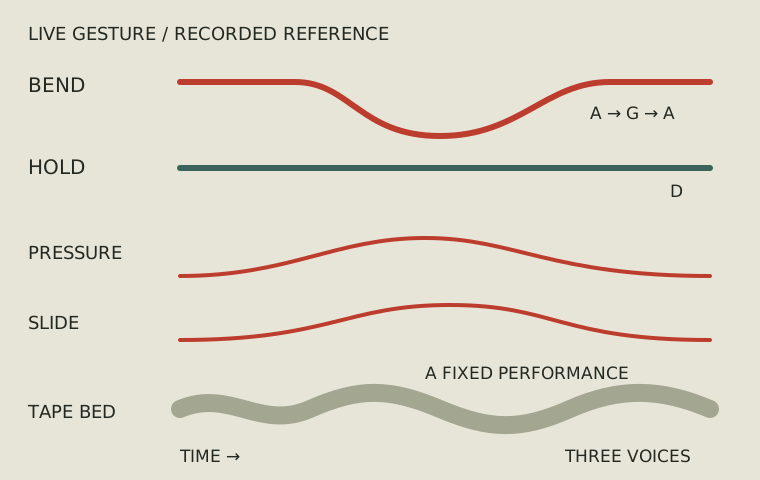
Hold D quietly. Add A above it with another finger. Keep the D stationary and draw the A slowly towards G, then back. Next repeat the pitch path while gradually increasing pressure on the moving note. Finally hold its pitch steady and explore slide. Separating the gestures makes it easier to hear what each one contributes before combining them. Use comfortable playing pressure; if only a hard push produces a useful change, adjust sensitivity or patch depth.
Then make it a lead
Change Playing mode to Solid lead / legato. The last-held-note behaviour now serves a single melodic line, so the two-finger independence exercise no longer applies. Let the printed drone supply the fixed point. Raise Bite towards 0.5, try Razor, and adjust the filter until the note has an edge without burying the bed. A little sub weight can anchor the sound; too much makes every gesture feel equally heavy.
Start Glide around 0.06 seconds. Play an overlapping pair of notes, then bend one held note. Those are different motions: legato glide smooths the transition between note targets; per-note bend follows the controller’s movement. Increasing glide is not the remedy for an incorrectly matched bend range. Pressure should sustain the musical intensity while the finger moves, rather than force every slide into a new attack.
Now bring in a small amount of tempo-related delay. Let one phrase finish before beginning the next, listening for the moment the repeat starts to act like a second player. Add shimmer only if it opens a useful upper register. If every held note becomes a cloud, shorten the release or reduce the return before changing the entire patch.
Record the relationship, not just the preset
Keep the drone on Tape, arm the Attractor track and record while the bed plays. For a first pass, capture audio: the performed gestures and instrument effects become part of the take. Record mode sits beside Record armed. Use Replace / punch when you want to replace a passage, or Overdub / add when you deliberately want another layer; adding every attempt can quickly obscure the phrase.
Auto provides a different working method for retaining performance and control changes. Begin with audio until you can hear the intended relationship, then compare an editable pass. Before another take, save the session and download a mix you want to keep. Browser disk storage is useful working storage, not an independent backup.
If you have no MPE controller, use the on-screen surface for a single bent line over the same bed, or play computer keys while adjusting the patch. This explores phrasing and colour, but it does not reproduce two independent pressure-sensitive fingers. If you have no audio interface, the computer’s output is enough for this internal recording exercise; no microphone is required.
Try this.
Make three 20-second phrases over the same printed drone: two independent notes with restrained expression, one legato lead with pressure and bend, then the same lead with a small delay return. Leave silence between phrases. Keep the bed and overall listening level consistent so that the change in playing remains audible. Use Share track in Noise/Signal to prepare a mix; add a note describing the controller, bend range and which passage you want listeners to discuss. Mark Work in progress and Feedback welcome if that is the invitation. Submissions wait for review.
Listen back
- Can you hear the stationary note remain steady while the other moves?
- Does pressure shape the middle of a note, or only make it louder at the start?
- Where does the delay answer the phrase, and where does it cover it?
- Would less modulation in the recorded bed make the live gesture more convincing?