Check the instrument before correcting the player
A slide that lands in the wrong place is not always a technique problem. First choose a plain, sustained sound with no pitch modulation and only a little ambience. Confirm that the controller and sound generator agree about pitch-bend range. Play a destination note directly, then slide to it from a nearby note and compare. A mismatch here makes physical distance unreliable, however carefully you move.
Check independent expression with two notes. Hold one steady while bending the other. If both move together, investigate the MPE configuration and routing before practising harder. Save this plain test sound. It becomes a reference whenever a new preset makes the controller feel strange, separating the basic response from the musical complexity of a particular patch.
Know what pitch correction is doing
LinnStrument’s panel documentation distinguishes quantisation of the initial strike from correction after a slide or vibrato. Initial quantisation centres a new note; Quantize Hold gradually returns a settled gesture to a semitone. The faster hold option can interfere with very slow movement. Other controllers have different systems, so learn the actual behaviour of your surface instead of assuming a universal MPE setting.
Start with the configuration that lets you hear your intention clearly. There is no virtue in disabling every aid at once. If the phrase needs a clean attack followed by a free slide, initial quantisation may serve it well. If you want to remain between pitches, a correction mechanism that pulls towards a semitone will work against that choice.
Record the same three-note phrase with two correction settings and listen without looking at the controller. Ask whether the pitch trajectory supports the phrase. A setting that feels impressive while playing may make the recorded line restless; a more restrained setting may allow a single bend to speak more clearly. Keep the result that suits the music rather than treating one configuration as a badge of skill.
Practise arrival, then motion
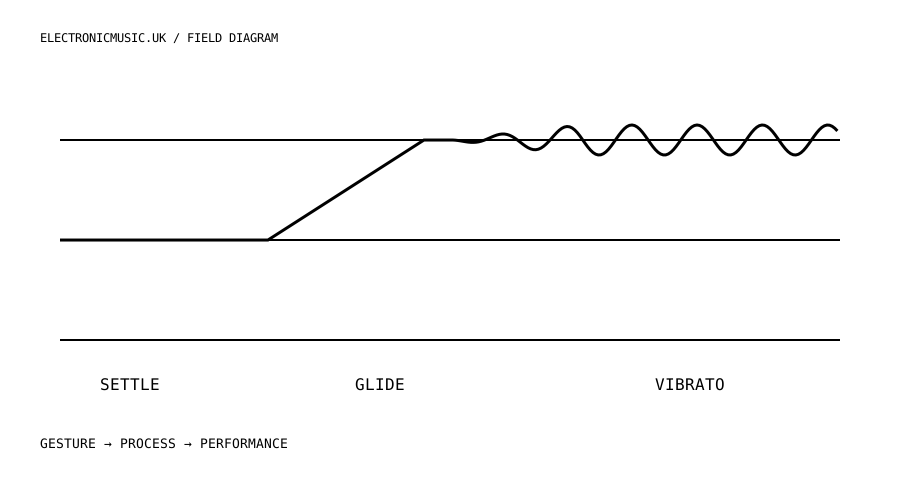
Choose two comfortable pitches and leave a breath between them. Play the first, move slowly to the second and hold still long enough to hear the arrival. Reverse the direction. Work in a small interval before expanding the distance. The purpose is to learn the relationship between touch, movement and sound, not to cover the whole controller immediately.
Then add vibrato after the note has settled. Begin with a narrow movement and a slow rate. Stop the vibrato without lifting the note. This last action is revealing: can you return to a stable pitch intentionally, or does every sustained note become permanently unsettled? Vary the moment when vibrato begins. A delayed vibrato can mark a phrase peak more clearly than continuous motion from the attack.
Keep pressure and timbre movement modest during this study. Once the pitch gesture is repeatable, add one other dimension. Increase pressure towards the arrival while keeping the slide duration unchanged, then try the reverse. If the added expression disrupts intonation, reduce its range rather than gripping harder. The mapping and the movement can be adjusted together.
For a two-note study, hold a quiet lower note and move the upper note by a small interval. Listen to the relationship between them, not only the upper pitch in isolation. The stable voice becomes a reference and a compositional partner. Change which finger carries the movement so the phrase is not limited to the easiest hand position.
Turn the exercise into a phrase
Make a short line with one straight note, one slide and one sustained note whose vibrato arrives late. Repeat it three times with the same pitch contour but different timing. This reveals whether expression is serving the rhythm and shape of the line. More movement is not automatically more expression; a still note can make the next gesture meaningful.
When a passage remains difficult, inspect the physical setup and the patch together. A controller positioned too far away encourages unnecessary tension. An overly sensitive pressure curve can make a relaxed touch sound unstable. An enormous pitch range may be appropriate for one gesture and inconvenient for another. Change one variable, then repeat the same phrase.
Keep a brief recording each week and write one observation about control rather than tone quality. Perhaps arrivals are cleaner, vibrato can stop without a pitch jump, or the second voice stays independent. These are useful signs of progress. The aim is a surface that follows a musical decision closely enough that you can forget the calibration while you play.
Try this.
Use a plain sustained patch. Compare direct and sliding arrivals, practise starting and stopping narrow vibrato, then hold one note while moving another. Record a three-note phrase under two pitch-correction settings.
Listen back
- Is the problem calibration, mapping or movement?
- Can vibrato end while the note continues?
- Which pitch-correction behaviour fits this phrase?