Listen beyond the finger
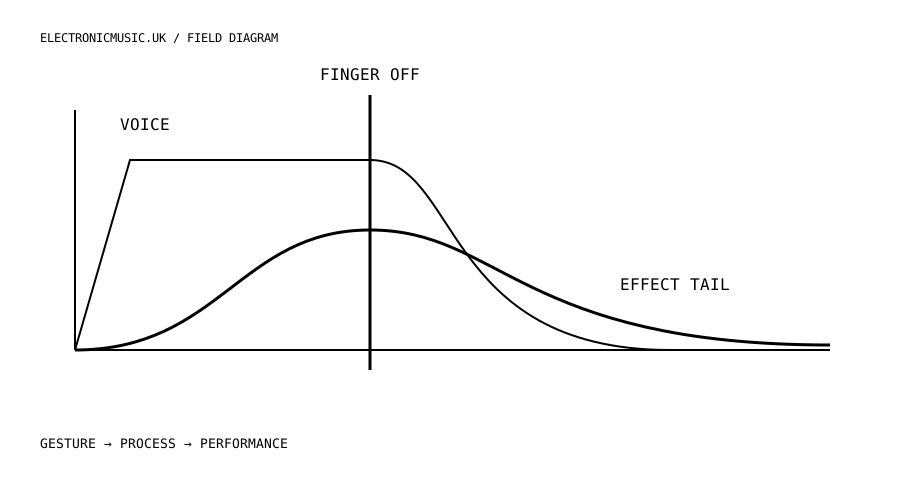
A note can continue long after the gesture that started it. The oscillator may be in its release stage, a resonator may still be ringing and a delay may be repeating an earlier version of the sound. These layers can respond differently to the next touch. Treating them as one undifferentiated tail makes expressive instruments harder to understand and harder to play deliberately.
Begin with one sustained voice and disable its effects. Bend a note, release it and listen to the remaining sound. Then play another note while the first is decaying. Repeat at different speeds and with several overlapping notes. You are finding out how this particular instrument handles expression during release and voice reuse. Do not assume every MPE engine makes the same choices.
Find the boundary between voice and effect
MPE places expressive messages on member channels so simultaneous notes can respond independently. A synth must interpret those messages in its voice system; an audio effect receiving a mixed stereo signal usually sees the resulting sound rather than the identity of each original note. Per-note expression and a shared delay therefore solve different parts of the performance.
Draw a simple route: voice, voice envelope, shared delay, output. Mark which controls affect the voice before it enters the delay and which change the delay itself. Pressure that brightens one voice before the send can leave bright repeats behind. Pressure mapped to a shared effect parameter can change the space surrounding several notes. Both can be useful, but they create different responsibilities for the hand.
Make a short comparison. In the first version, map pressure only to the source’s tone. In the second, use a separate global control for the delay’s feedback or wet level. Play the same phrase. Listen for whether the last note is unintentionally controlling the atmosphere around all the earlier notes. Keep the global gesture explicit if that is the intended result.
Design three kinds of ending
Create a stopped ending, a natural decay and a suspended ending. For the stopped version, the dry voice should finish clearly and the effect should not conceal the boundary. For natural decay, allow the timbre to settle as the note fades. For suspension, remove the live source while letting a repeat or reverb continue. Each ending makes a different promise about what comes next.
Keep enough control range near quiet values to shape the release. If pressure reaches silence abruptly, small changes in finger weight can sound like accidental gates. If a release is so long that every phrase overlaps the next, individual gestures lose their outline. Adjust the curve and envelope together while playing the actual phrase, rather than perfecting either in isolation.
Test the sustained pedal separately from finger release if your setup uses one. Hold a chord, lift one finger and move another. Then release the pedal while a new note sounds. Note which voices respond and whether the result matches your expectation. A pedal is another source of state in the instrument, so it needs its own rehearsal rather than being assumed to behave like an acoustic piano.
Avoid solving every release problem with more reverb. Ambience can make a transition forgiving, but it can also hide a discontinuity until the patch is used dry or at a slower tempo. Establish a convincing envelope first. Add the shared space afterwards and decide how much of the ending belongs to the source and how much belongs to the room you have made.
Make the tail part of the phrase
Play a short motif, then leave a gap long enough for its repeats to become the foreground. Answer that tail with a quieter note instead of immediately filling the space. This is a useful MPE exercise because the next gesture must respond to sound already in motion. The instrument’s memory becomes a partner rather than a constant background wash.
Record one passage with short releases and one with long releases. Compare how many notes you actually need. A dense finger pattern may be appropriate for a dry patch yet excessive when each note keeps evolving. Change the composition when the sound changes; do not force the same hand movement onto every preset.
Finish by documenting the intended end behaviour beside the preset. Write whether pitch should remain bent during release, whether shared effects continue after a panic action, and which control clears accumulated sound. These are design decisions to verify in the implementation, not universal guarantees. An expressive preset feels more complete when its endings are as intentional as its attacks.
Try this.
Make stopped, decaying and suspended endings from one MPE patch. Test bent-note release, overlapping voices and pedal release with effects disabled, then restore one shared delay and perform a call-and-response with its tail.
Listen back
- Which part of the tail still belongs to an individual voice?
- Does the next gesture change earlier notes unexpectedly?
- What deliberate action ends the accumulated sound?